
Change Framework
The Four Quarters
Why lasting change in a place needs Church, Commercial, Civic and Community working together.
Everything rises or falls on leadership — and that's as true of a place as it is of an organisation. Whether it's a neighbourhood, a town or a whole region, the shape of a place is set by its leaders. To have the biggest impact, the focus has to be on the areas where the narrative of a place is actually being written.
Over years of connecting leaders across very different worlds, Ian has come to see a place's leadership as four strategic quarters: Church, Commercial, Civic and Community. Each shapes people and place in its own way — and none can transform a community on its own. Here's what the four quarters are, and why lasting change depends on them working together.
Knowing your place
The lens through which you see your community shapes what you believe is possible for it. What you call your place — hamlet, village, town, city or borough — quietly sets the boundaries of where you think it can go. Naming it well matters.
Doncaster shows how this works. Through One Heart One Voice, leaders came together to describe and plan for Doncaster as a “city” long before it was official — using the term consistently from 2006, because that was where they believed it was heading. In 2022, Doncaster was granted city status — a milestone that had, in a sense, already been claimed in how the place was seen. The lens came first; the reality followed.
Within any place, culture is shaped by its key people of influence — the “movers and shakers” who make things happen. For better or worse, these leaders set the narrative and push a place in a direction. Understanding who they are, and which quarter they lead from, is where transformation begins.
Spheres of influence
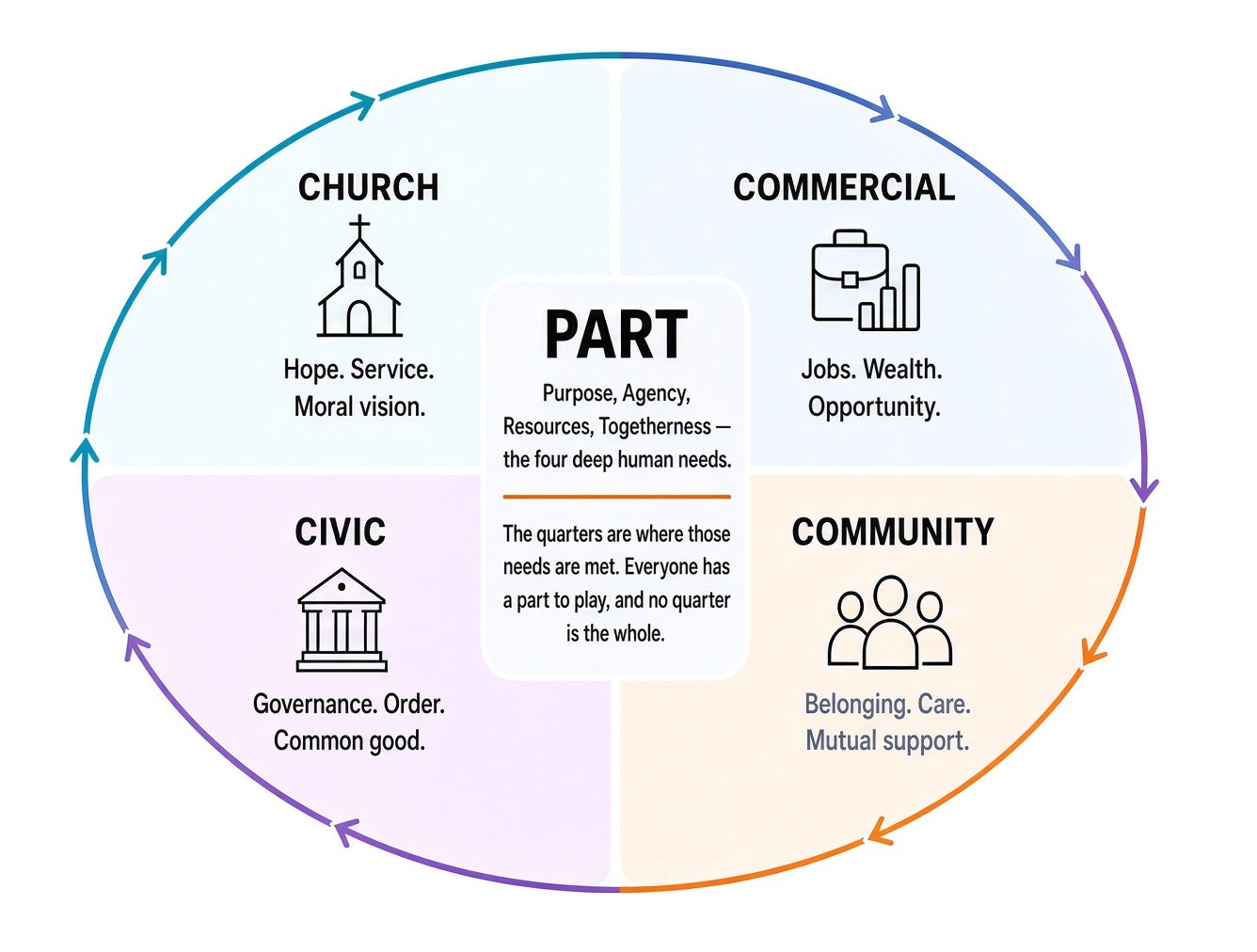
Think of the leadership of a place as divided into four quarters. Each represents a distinct sphere of influence, with its own leaders, language and levers of change. Explore each one:
Church
Faith communities working together in unity across a locality — a source of hope, service and moral vision.
Explore Church →Commercial
Businesses and enterprise that shape the economy of a place — creating jobs, wealth and opportunity.
Explore Commercial →Civic
Public institutions and the ceremonial life of the region — governance, order and the common good.
Explore Civic →Community
Grassroots networks and the social fabric that holds a place together — belonging, care and mutual support.
Explore Community →The point isn't to ring-fence anyone. In practice the quarters overlap, and many leaders have roles that cross more than one — that intersection is a strength, not a problem. Developing a portfolio of activities that grows and connects leaders across these quarters is the key to real influence in a place.
Why all four, and why together
Most attempts at community change fail for the same reason: each quarter works in isolation. Business tries to fix things through enterprise alone. Councils reach for policy alone. Churches and charities each tackle the same needs from their own corner, often unaware of one another. Effort is duplicated, resources are wasted, and the deeper problems — which cut across every quarter — go unresolved.
The four quarters are interdependent. A thriving economy needs a healthy civic framework. Strong communities relieve pressure on public services. Faith and community groups reach people that institutions can't. When the quarters collaborate — sharing knowledge, aligning effort, crossing the old boundaries — change becomes possible that no single quarter could achieve alone. That's the whole conviction behind this framework: transformation is a team sport.
What every place needs
Every place runs on four deep human needs — and they spell a single word: PART. The quarters are where those needs are met: the social contexts in which people come together to work for the good of their place. Everyone has a part to play, and no quarter is the whole.
Purpose
People are looking for meaning, relevance and hope — a reason that their life and their place matter. A community that offers genuine purpose gives people something to belong to and build towards, turning residents into stakeholders. Where purpose is absent, apathy and drift fill the gap; where it's present, energy and commitment follow.
Agency
When people feel life is being done to them, they disengage; when they feel they have a say, they take ownership. Agency is the sense of control that comes from being genuinely included in shaping your place. Transformation that is handed down rarely holds; transformation people help author takes root, because they own it.
Resources
Places are transformed through their assets — the buildings, spaces, money, skills and institutions a community can draw on. Reclaiming and repurposing what's there brings hope and life. The breakthrough comes when those assets are pooled and shared across the quarters rather than guarded — when one's spare capacity becomes another's missing piece.
Togetherness
Everyone is looking to belong. Families, friendships and community are the social fabric that holds a place together, and they're vital to anything you hope to achieve in it. Togetherness between leaders, across the old boundaries, models and unlocks the togetherness a whole community needs.
Purpose, Agency, Resources, Togetherness. Meet these four and a place has what it needs to flourish; neglect any one and transformation stalls. No single quarter can supply them all — which is exactly why everyone has to play their PART.
Putting the framework to work
The four quarters aren't just a way of describing a place — they're a way of diagnosing it. Ask of your own community: which quarters are strong, and which are weak? Where are they already collaborating, and where do they barely know one another? The biggest opportunities for transformation usually sit in the gaps between the quarters, where a connection that doesn't yet exist could unlock progress on both sides.
Wherever a leader works — in business, public life, community work or the church — they already sit in one of these quarters. The most valuable question isn't “how do I do more in my quarter?” but “who in the other three should I be building a bridge to?”
It also takes a crowd
Leaders don't transform a place on their own. Behind every leader is a crowd — the people who, joined together, turn a good idea into real momentum. One leader can set a direction; it takes a crowd to carry it there.
That's why the quarters are never just about the handful of people at the top. Each one is really a network — a leader connected to the people around them, who are connected to others in turn. Reach one well-placed leader and you don't reach one person; you reach everyone in their orbit. Mobilising those crowds, and connecting them across the quarters, is where a framework stops being a diagram and starts becoming a movement.
Gather the right people around a shared vision and the effect is real: relationships form, trust grows, and a crowd of leaders starts pulling in the same direction. It's genuinely powerful, and it builds momentum you can feel.
The four quarters take that momentum further. They map the crowd onto the real leadership of a place — church, commercial, civic and community together — so the energy of a gathering doesn't just circulate among the already-committed, it reaches the people with the authority to make change stick. Build on what a movement starts, connect it across all four quarters, and that shared vision gains the reach to transform a place — whatever its size or make-up.
How well is your place working together?
Take the free Place Assessment and see how your place is doing across the four quarters — Church, Commercial, Civic and Community — and where the next connection could make the biggest difference. It takes about five minutes, and you'll get a tailored profile with practical next steps.
Transformation is a team sport
Exploring how the four quarters could work in your place? Ian would be glad to think it through with you.